Choosing a Chinese chew-toy supplier takes more than comparing prices or browsing colorful product photos. The right partner should explain materials, sizing, durability, and quality checks in clear terms. Ask how each toy is tested, whether material specifications are available, and how the supplier handles defects. A polished sample matters. So does consistent production.
The American Pet Products Association’s 2024 State of the Industry report estimated U.S. pet-industry spending at $147 billion in 2023 and projected $150.6 billion for 2024. These figures describe the wider pet market, not chew toys alone, but they show why buyers need careful supplier evaluation. For product selection, veterinary behaviorist Dr. Marty Becker’s safety guidance can be paraphrased simply: no chew toy is right for every dog, and owners should supervise chewing. Fit matters. A toy that is too small may be swallowed; one that is too hard may risk tooth damage. The question of how to choose the right chew toys for dogs should guide both product design and sourcing decisions. Compare samples against the intended dog’s size, chewing strength, and play style. Check edges, seams, odor, and material consistency under ordinary handling. These checks cannot guarantee safety, and a sample cannot reveal every production flaw. Still, they offer a more reliable starting point than a supplier’s claims alone. This guide outlines practical questions for assessing China-based suppliers, while recognizing that real-world wear can be difficult to predict.
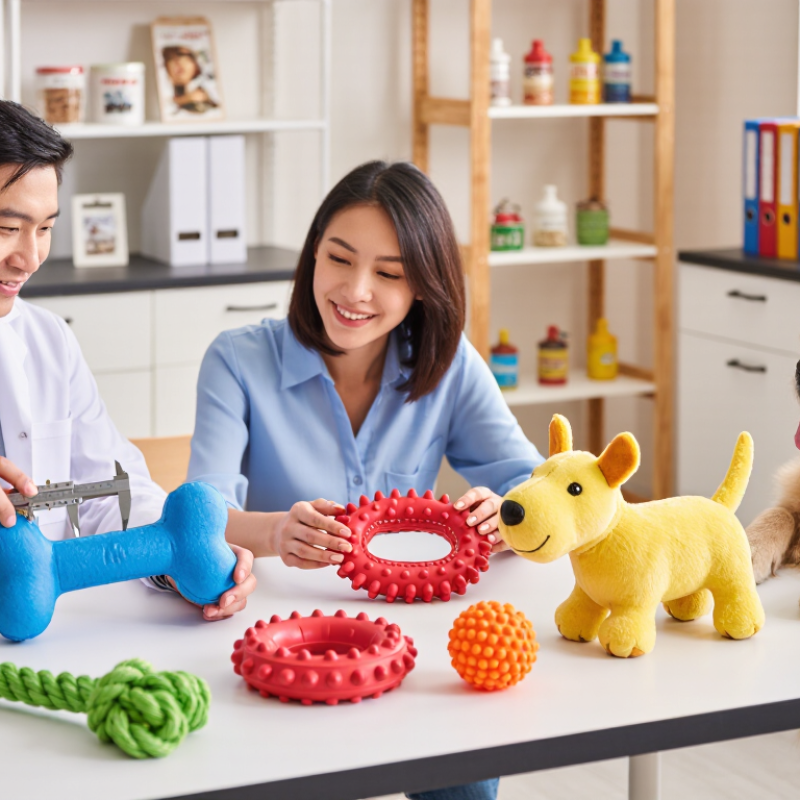
China’s dog chew toy supplier landscape includes direct factories, trading companies, and sourcing firms. Some suppliers specialize in molded rubber or TPR toys, while others focus on nylon, fabric, or mixed-material designs. Production capabilities, minimum order quantities, and customization options can vary widely, even among suppliers offering similar products. Ask where production takes place and which steps are handled in-house.
A detailed catalog is useful, but it cannot confirm consistent quality. Request samples from the same production process used for bulk orders. Check seams, edges, material consistency, and packaging details. Match the toy’s size and firmness to its intended dog size and chewing style. Supplier records for material specifications and quality checks also help clarify what is being purchased. One imperfect sample may reveal a real issue, or simply need a closer review.
Tips: Compare written specifications, sample results, and lead times side by side. Ask how defects are recorded and addressed. Keep the questions specific. A low quote alone is a weak basis for choosing a supplier.
Before requesting quotes, define the chew toy by dog size, chewing strength, material, dimensions, and intended use. A 4-inch rubber chew for a small dog needs different bite and durability checks than a thick nylon chew for a powerful chewer. Specify acceptable weight variation, surface finish, packaging, and batch coding. Vague requirements invite inconsistent samples. That gets expensive.
The American Pet Products Association’s 2025 State of the Industry report estimates U.S. pet-industry spending reached $152 billion in 2024. This figure covers the wider pet market, not chew toys alone, but it shows why supplier claims deserve careful review. Ask for material declarations, traceable batch records, and recent test reports from a laboratory accredited to ISO/IEC 17025. Reports should identify the tested model and cover relevant chemical and mechanical risks, such as restricted substances, sharp edges, breakage, and detachable parts. A report is not a pass. Confirm that the tested sample matches the production item, and check which rules apply in each sales market. I still ask an awkward question: what changes when the factory changes material suppliers? Request written change-control procedures, then compare pre-production samples with shipment samples. Keep the evidence on file.
When evaluating dog chew toy suppliers, look beyond a polished catalogue. Ask for material specifications, production capacity, and recent quality records. A capable supplier should explain how toy size, hardness, and seam strength are controlled across batches. Request samples in the exact materials and dimensions you plan to order. Details matter. Compare their weight and finish, and check for uneven seams, sharp edges, or loose parts. These simple checks cannot replace laboratory testing, but they can reveal basic inconsistencies early.
Ask how inspections work at each stage: incoming material checks, production-line sampling, and final review before packing. Request test reports that identify the tested product and method, rather than a certificate with no clear scope. If possible, review a sample batch and ask how defects are recorded and corrected. Small gaps show.
A factory visit or live video walkthrough can help you assess equipment, storage, and how workers handle finished toys. Also confirm whether production schedules and batch records are shared consistently. No assessment is perfect; a supplier may perform well on samples yet struggle with a larger order. Agree on measurable specifications and inspection points before production begins.
When comparing China dog chew toy suppliers, look beyond the unit price. A low quote may exclude custom packaging, sample fees, or inspection costs. Ask for a written breakdown covering material, size, packaging, and any setup charges. Compare equivalent products, such as chew toys with the same dimensions and material thickness. Otherwise, the cheapest offer may not be the best value.
Minimum order quantities can vary by material, color, and customization. A supplier may accept a small sample order but require a much larger production run for custom colors. Confirm the MOQ for each version, and ask whether mixed designs can share one order. Request a sample before committing; check seams, surface finish, and packaging yourself. I have seen a neat sample raise expectations too high, so ask how production items are checked as well.
Tips: Compare shipping options by total landed cost, not freight alone. Ask for estimated transit times, carton dimensions, and shipping terms. Air freight can suit urgent, compact orders, while sea freight may cost less for larger shipments but take longer. Get estimates for your delivery location, and leave room for delays. Small details matter.
Compare like-for-like quotes by unit price, minimum order quantity (MOQ), and shipping terms. The chart shows indicative transit-time ranges; actual delivery times depend on route, carrier, customs, and final destination.
When comparing suppliers: Request quotes for the same toy material, size, customization, and packaging. Check the MOQ, unit price, sample or tooling fees, shipping method, and Incoterm together; the lowest unit price may not mean the lowest total landed cost.
Testing samples is where supplier claims meet a dog’s jaw. Request several production-representative pieces, not a hand-finished showcase sample. Check dimensions, weight, seams, odor, and surface finish. Then inspect each toy after supervised chewing. Look for cracks, loose layers, sharp edges, or pieces a dog could swallow. Keep notes. A simple photo beside a ruler can reveal small changes between batches.
APPA’s 2024 State of the Industry report put U.S. pet-industry spending at $147 billion in 2023. Its 2023–2024 National Pet Owners Survey estimated 65.1 million U.S. dog-owning households. These figures show a substantial market, not proof that any chew toy is safe or durable. Ask suppliers for material specifications and test reports tied to the exact sample and batch. Confirm the test method, date, and laboratory; a certificate without these details is hard to assess.
Test more than one size and color, since processing can affect hardness and fit. Ask the supplier how it controls material changes and records batch numbers. Compare responses with the documents provided. A polished sample once distracted me from an uneven seam; I should have checked more closely. Request replacement samples after any material or design change, and agree on written inspection criteria before placing an order.
| Evaluation Area | Sample Test or Evidence to Request | Buyer-Defined Acceptance Check | Weight | Score (0–5) |
|---|---|---|---|---|
| Sample safety and design | Inspect the sample for sharp edges, loose parts, cracks, exposed components, and pieces that could detach during intended use. | Set the intended dog size and use case in advance. Reject samples with hazardous detachable parts or defects that create an obvious injury or ingestion risk. | 20% | ____ |
| Chew durability | Arrange supervised use by dogs that match the intended size and chewing style. Record wear, deformation, breakage, and any detached pieces. | Define the test duration and acceptable wear before testing. Compare all samples under the same conditions; stop testing if damage could create a safety risk. | 20% | ____ |
| Construction and finish | Check seams, molded joins, surface finish, edges, and consistency of dimensions and weight across multiple samples. | Agree on the product drawing and tolerances. Samples should have no open seams, sharp flash, or material defects outside the approved specification. | 15% | ____ |
| Material traceability | Request the material specification and any relevant test reports for the exact product or material. Confirm that document details match the sample and intended market. | Check report dates, tested materials, product identification, and issuing laboratory details. Do not treat a report for a different item as proof for the sample under review. | 15% | ____ |
| Production consistency | Request samples from more than one production lot when available; compare color, dimensions, weight, finish, and construction. | Approve a written reference sample and specifications. Ask how production batches are checked against the approved sample. | 10% | ____ |
| Quality-control process | Ask for the inspection checklist, defect classification, corrective-action process, and records available for a typical order. | Confirm that incoming materials, production, and finished goods have defined checks, with a process for recording and resolving nonconformities. | 10% | ____ |
| Communication and documentation | Evaluate response clarity and request a written quotation, product specification, packaging details, sample terms, and order timeline. | Key specifications, responsibilities, costs, and timing should be documented clearly and confirmed before an order is placed. | 5% | ____ |
| Commercial fit | Compare minimum order quantity, sample and tooling charges, payment terms, production lead time, and shipping assumptions. | Check that the quoted terms fit the purchasing plan and state what is included, what may change, and how delays or defects will be handled. | 5% | ____ |
| Weighted total: multiply each 0–5 score by its weight, then add the results. Use the same test plan for every supplier being compared. | 100% | ____ / 5 | ||
| Note: Acceptance criteria are buyer-defined checks, not universal safety certifications. Confirm applicable product and testing requirements for the destination market before purchase. | ||||
Suppliers include factories, trading companies, and sourcing firms. Some make molded rubber or TPR toys; others focus on nylon or fabric.
Ask which production steps happen in-house, where production takes place, and how capacity is managed. Request recent quality records. Details matter.
Check the seams, edges, firmness, weight, surface finish, and packaging. Match the toy’s size and hardness to its intended dog size and chewing style.
No. A polished sample may not represent a large order. Ask how production batches are checked and how defects are recorded and corrected.
Request material specifications and test reports that identify the product and testing method. A certificate without a clear scope may tell you little.
Ask for a written breakdown of materials, dimensions, packaging, sample fees, inspection costs, and setup charges. Compare equivalent products, not just unit prices.
Confirm the minimum for each material, color, and custom version. Ask whether different designs can share an order. Requirements may vary.
Compare total landed costs, carton dimensions, shipping terms, and estimated transit times. Air freight can suit urgent, compact orders; sea freight may take longer. Leave room for delays.
Choosing a reliable dog chew toy supplier in China starts with understanding the available manufacturers and matching their products to your needs. Define the toy types, materials, sizes, durability, and safety requirements before requesting quotes. Confirm that suppliers can provide relevant quality documentation and explain how they inspect materials and finished products. These steps help you evaluate whether a supplier’s capabilities align with your product specifications and intended market.
Compare pricing alongside minimum order quantities, production capacity, lead times, and shipping options rather than focusing on unit cost alone. Request samples to assess construction, material quality, and consistency before placing a larger order. Clear communication, transparent processes, and dependable sample results can help identify a suitable long-term partner. Keeping your product requirements in mind also makes it easier to understand how to choose the right chew toys for dogs and select a supplier that can deliver them reliably.

Pitbull Toy